All US state names in French and how to learn them easily

Last week, one of my students wrote “La Nevade” instead of “Le Nevada” in her homework. When I corrected it, I fell down a rabbit hole.
Countries and states that end with -a often end with -e in French, so why was this a mistake?
How many rules affect the names of US states in French?
I went online to find if someone had figured it out.
I only found chaos.
As often, French teachers only shared lists with no logic. Are learners just supposed to make sense of it?
So, I did it.
I uncovered all the rules for naming US states in French, including their genders and how to use them in a sentence.
Then I put them all in an actionable, easy to learn, under 10-minute video.
If you like this video, click here to subscribe to my YouTube channel. I make new videos regularly about what it takes to become a French speaker.
Feminine States
Their names have been translated, probably because they are among the oldest, and they are all on the coasts. If they end in a the spelling is changed to e. When a state is feminine we use the article La and the preposition En.
Pennsylvania - Pennsylvanie
California - Californie
Virginia - Virginie
West Virginia - Virginie Occidentale
North or South Carolina - Caroline Nord or Sud
Georgia - Géorgie
Florida - Floride
Louisiana - Louisiane

Masculine States
You will have to pronounce the masculine states' names the French way. Listen to the video so you can practice!
The majority are masculine states. Their names haven't been translated except for New Mexico. I believe the names haven’t been translated because the French haven’t heard much about them since they are in the center of the country and are less populated. We use the article Le for masculine states. If the state starts with a consonant we use the preposition Au or Dans le:
Nevada - Nevada
Montana - Montana
Wyoming - Wyoming
Colorado - Colorado
New Mexico - Nouveau-Mexique
North or South Dakota - Dakota Nord or Sud
Nebraska - Nebraska
Kansas - Kansas
Texas - Texas
Minnesota - Minnesota
Wisconsin - Wisconsin
Missouri - Missouri
Michigan - Michigan
Kentucky - Kentucky
Tennessee - Tennessee
Mississippi - Mississippi
Maine - Maine
New Hampshire - New Hampshire
Vermont - Vermont
Massachusetts - Massachusetts
Connecticut - Connecticut
New Jersey - New Jersey
Delaware - Delaware
Maryland - Maryland
If it starts with a vowel, we use the prepositions En or Dans l’:
Oregon - Oregon
Idaho - Idaho
Utah - Utah
Arizona - Arizona
Iowa - Iowa
Oklahoma - Oklahoma
Illinois - Illinois
Arkansas - Arkansas
Indiana - Indiana
Ohio - Ohio
Alabama - Alabama
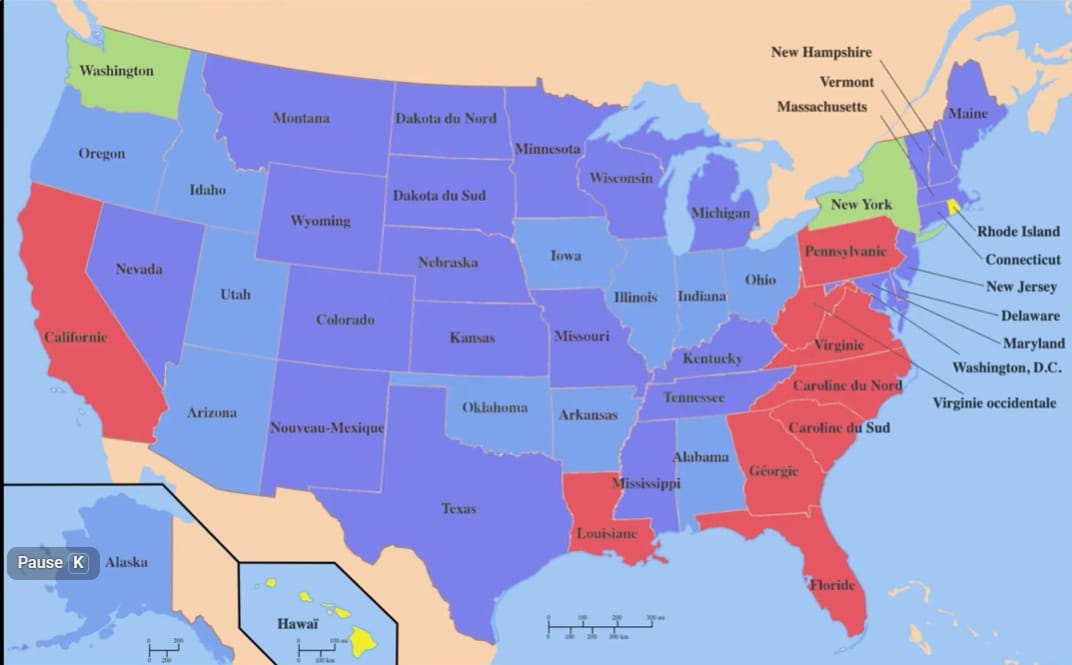
Other states:
- To make it clear that you mean New York State, or Washington State and not the cities of the same name, we use L’Etat de New York and L’Etat de Washington, and use the preposition Dans. L’etat is masculine so these two states are masculine.
- For islands, including Rhode Island (which isn’t an island) we use the preposition à as if it were a city. They are feminine, so we use the article La. The exception is Puerto Rico (which is not a state) because Porto is masculine in Spanish.
Your next steps
If you like this way of learning French, you will love to learn with me as a student or client. Please check out:
- My 1-1 coaching program, The French Transformation, if you need to improve your French fast.
- My group program, The French Fluency Accelerator, if you’d like to join a community of students from all over the world. We have weekly practice calls together and the best online video library to learn French.
Pro tip: you don’t need to choose!
All my 1-1 clients are invited to join the French Accelerator free of charge.
Feel free to book a call with me now to discuss options.
If you liked this, here's some more:
10 French phrases you need to know before your first trip to France

French pronunciation guide for beginners - greetings and honorifics
About the Author

Angel Pretot is a French learning coach. He works online with English speakers from all over the world, helping them learn French fast and become fluent.
You can work with him, in his one-on-one program the French Transformation, take some of his self-study courses, or join a global community of French learners in his group program the French Fluency Accelerator.